The Bone Chapel of Sedlec: A Church Built From 40,000 Dead
 2026/07/07
Beneath a small chapel in the Czech town of Kutná Hora, the bones of tens of thousands are arranged into chandeliers, garlands…

Every civilisation that has ever existed has been, among other things, a machinery for managing the dead. Long before writing, before cities, before agriculture, human beings were digging graves, arranging bodies with deliberate care, and leaving behind ochre, flowers and grave-goods for reasons we can only partly reconstruct. Mortality is the one experience no culture has been able to opt out of, and so the ways people have chosen to bury, mourn, memorialise and interpret their dead form one of the deepest and most revealing records we possess of what it has meant to be human.
This section approaches death not as a morbid spectacle but as a subject worthy of the same seriousness a historian brings to war or a naturalist brings to migration. What follows is an overview of the terrain: the art that grew up around dying, the strange architecture built to house the departed, the astonishing variety of customs by which the living tend to the dead, the biology of what actually becomes of a body, the catastrophes that rewrote whole societies, and the quiet contemporary movement urging people to look at mortality again with open eyes. The aim throughout is beauty and gravity rather than shock.
The Latin phrase memento mori — “remember that you must die” — names one of the most persistent themes in Western art. It is not a phrase of despair but of perspective. To keep death in view was, for much of European history, understood as a corrective against vanity and a spur toward a considered life. The motif appears in skulls tucked into the corners of Renaissance portraits, in hourglasses and guttering candles, and in the elaborate still-life genre known as vanitas, where wilting flowers and rotting fruit sit beside coins and instruments of learning to remind the viewer that all earthly things decay.
In the wake of the later medieval plagues, a distinctive image took hold across Europe: the danse macabre, or Dance of Death. In frescoes, church murals and later printed books, a procession of skeletons leads away people of every rank — pope and emperor, merchant and labourer, child and bishop — each partnered by a capering figure of Death. The message was pointedly democratic. Death respected no title and could be bargained with by no one. Hans Holbein the Younger’s celebrated woodcut series, published in the sixteenth century, gave the theme its most enduring artistic form, and the image of the equalising skeleton has never entirely left European visual culture since.
Few societies ritualised grief as elaborately as the nineteenth-century Victorians. Mourning was governed by an intricate etiquette of dress and conduct, and it was worn, quite literally, on the body. Widows were expected to pass through stages of mourning marked by specific fabrics and colours, beginning with dull black crape and only gradually admitting grey and mauve. The death of Prince Albert in 1861 and Queen Victoria’s decades of visible grief lent the whole culture a royal template.
Objects carried much of the emotional weight. Mourning jewellery — brooches, rings and lockets — was often woven from or set with a lock of the deceased’s hair, an intimate relic of someone who could no longer be touched. Jet, the black fossilised wood mined at Whitby, became the fashionable material for mourning ornaments. These artefacts, sombre and strangely tender, belong to the same impulse that fills a modern the Cabinet of Curiosities: the wish to hold onto a physical trace of the vanished.
When photography became widely available in the mid-nineteenth century, it arrived in a world with high mortality, especially among infants and children, and for many families a photograph might be the only likeness they would ever possess of a loved one. This gave rise to post-mortem photography, in which the recently deceased were photographed, sometimes posed as if sleeping or seated among the living. To modern eyes the practice can seem unsettling, but it was born of ordinary love and grief in an age when a single image was precious. It is worth resisting the temptation to read these photographs as macabre; they are, more truthfully, monuments of devotion.
Across much of Europe, cemeteries were never meant to be permanent. Land was limited, especially inside walled towns, and graves were frequently reused. When a grave was reopened, the older bones were exhumed and moved to a charnel house or ossuary — a dedicated building or chamber for the storage of human remains. Far from being hidden away in shame, these bones were often arranged with extraordinary, even reverent, artistry.
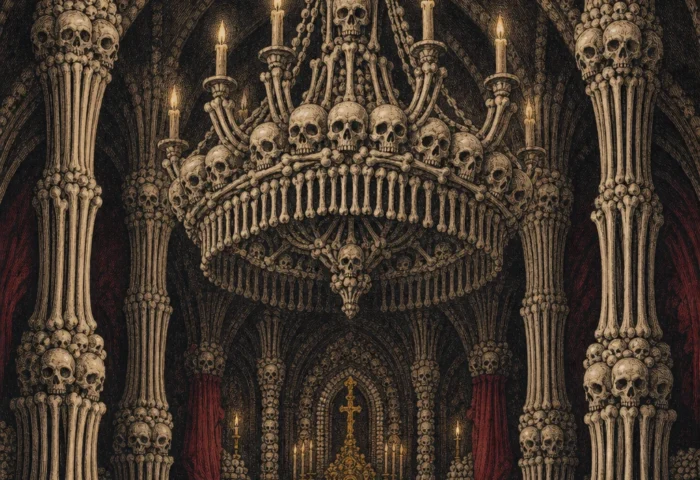
The small chapel at Sedlec, in the Czech town of Kutná Hora, is perhaps the most famous example. According to long-standing accounts, soil from the site was believed to have been sanctified by earth brought from Jerusalem, making it a coveted burial ground and filling the cemetery far beyond its capacity, a process worsened by plague and war. In the late nineteenth century a woodcarver was engaged to bring order to the accumulated remains, and the result is astonishing: garlands of skulls, a great chandelier said to incorporate many bones of the human body, and heraldic designs, all composed from the dead. Visitors to the Sedlec Ossuary often report not horror but a strange, hushed dignity. The arrangement was intended as devotion, not decoration — a reminder, again, of memento mori.
Beneath the streets of Paris lie the remains of a great many people, gathered into the tunnels of former limestone quarries. In the late eighteenth century, the overcrowded and unsanitary cemeteries of the city — above all the notorious Cemetery of the Innocents — were emptied over a period of years and their contents transferred underground. In the ossuary that resulted, bones were stacked and arranged into walls of skulls and long bones, punctuated by inscriptions urging the visitor to reflect on death. What began as a public-health necessity became, over time, one of the most visited and most contemplative spaces in the city.
In Rome, beneath the church of Santa Maria della Concezione, the Capuchin friars created a series of small chambers decorated with the bones of thousands of their own order. Here the intention is explicitly spiritual: an inscription associated with the crypt reminds visitors that the friars there were once as the living now are, and that the living will one day be as they are. The message is not a threat but an invitation to humility — a theme that echoes across every ossuary and speaks to the same instinct explored throughout Crime & Punishment, where societies likewise put mortality on public display to make a moral point.
The impulse to keep the dead visible, rather than sealed away, recurs far beyond Europe. Several motives run through these practices:
The methods by which human societies dispose of and honour their dead are remarkably varied, and each reflects a coherent worldview about the body, the soul and the community. These practices deserve to be described with care and without condescension; what looks unusual from outside is, from within, an act of love, duty or faith.
In parts of the Tibetan plateau and among some Mongolian communities, a practice sometimes called sky burial is traditional. The body of the deceased is offered on a mountain site to vultures and other scavenging birds. In a landscape where wood is scarce and the ground is often frozen, cremation and earth burial are impractical, but the custom is far more than a pragmatic solution. Within a Buddhist framework, the body after death is understood as an empty vessel, and returning it to nourish other living beings is regarded as a final act of generosity. What might appear stark to an outsider is, in context, an expression of compassion and of the impermanence at the heart of the tradition.
In parts of highland Madagascar, some communities have practised a ceremony known as famadihana, sometimes translated as “the turning of the bones”. At intervals of several years, families exhume the remains of their ancestors, rewrap them in fresh cloth, and celebrate with music, dancing and feasting before returning them to the tomb. The occasion is joyful rather than sombre. It reflects a belief that the ancestors remain part of the family and that the bonds between the living and the dead must be periodically renewed and honoured. The custom has become less universal in recent decades, but it remains a powerful example of death treated as continuity rather than rupture.
In Mexico, the Day of the Dead — Día de los Muertos, observed in early November — is among the best-known death customs in the world. Families build home altars, or ofrendas, decorated with marigolds, candles, photographs and the favourite foods of the departed, believing that the souls of loved ones return briefly to visit. Sugar skulls and the elegant skeleton figures inspired by the artist José Guadalupe Posada’s Calavera Catrina give the festival its distinctive imagery. The tone is affectionate and often humorous. Rather than a day of fear, it is a day of welcome, blending Indigenous traditions with Catholic observance into something wholly its own.
In Jewish tradition, the week following a burial is marked by shiva, from the Hebrew word for seven. The immediate mourners remain at home and receive visitors, who come to comfort them and to share memories of the deceased. Everyday concerns are set aside; mirrors may be covered, and mourners often sit on low stools as a sign of grief. The structure of shiva reflects a profound communal wisdom: it gives grief a defined time and place, ensures the bereaved are not left alone, and marks a gradual, staged return to ordinary life. Many observers of contemporary attitudes to death note how much such structured mourning offers that modern secular life often lacks.
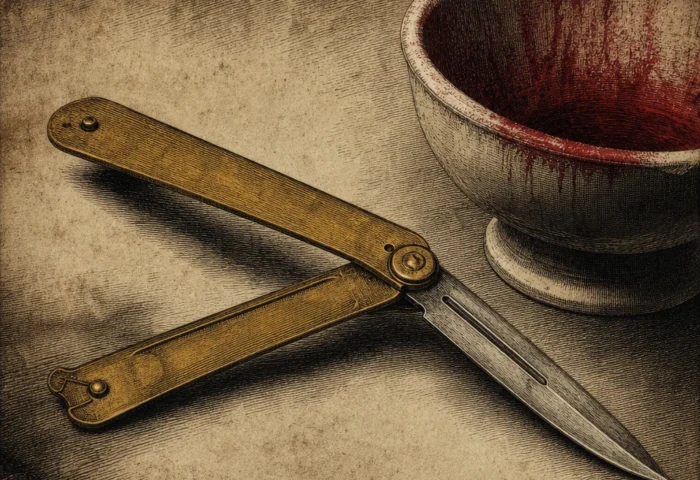
Alongside its cultural dimensions, death is a biological process, and the sciences that study it have their own long and careful history. Understanding what physically becomes of a body demystifies much that folklore once made frightening, and it underpins fields from medicine to forensic investigation. The instruments of that inquiry, from the anatomist’s tools to the barber-surgeon’s lancet, tell their own story of how the living have sought to understand the dead.
After death, the body passes through a series of well-documented stages. In the hours following death, chemical changes cause the muscles to stiffen — the familiar rigor mortis — which then passes as those same tissues begin to break down. Internal enzymes start a process of self-digestion, and the vast community of microorganisms that lives within every human body, no longer held in check, drives the transformation forward. The rate depends heavily on temperature, moisture, and whether the body is buried, exposed or submerged. Decomposition can seem the most disquieting aspect of mortality, but biologically it is simply the reintegration of a body into the wider cycle of life — the same recycling of matter that sustains every ecosystem.
Under certain conditions, decomposition is arrested and the body is preserved. This can happen naturally: extreme cold, as with bodies recovered from glaciers, or extreme dryness, or the peculiar chemistry of peat bogs, whose acidic, oxygen-poor waters have preserved so-called “bog bodies” from the Iron Age with their skin and features remarkably intact.
Deliberate mummification is best known from ancient Egypt, where over many centuries an elaborate practice developed to preserve the body for the afterlife. This involved the removal of internal organs, prolonged desiccation using natron salts, and wrapping in linen, accompanied by extensive ritual. The Egyptians were not alone: the Chinchorro people of what is now northern Chile practised deliberate mummification thousands of years ago, and various other cultures have preserved their dead by smoke, cold or other means. In every case the underlying wish is recognisable — to hold decay at bay and keep something of the person present in the world.
The scientific study of what happens to remains after death is called taphonomy, a term borrowed from palaeontology. In its forensic application, researchers study the process of decomposition in controlled outdoor settings, often known informally as “body farms”, where donated human remains decompose under observed conditions. The first such facility was established in the United States in the early 1980s, associated with the anthropologist William Bass. The knowledge produced there is not idle: it helps forensic investigators estimate how long a person has been dead and interpret the circumstances of a death, work with direct consequences for justice. It is a field built entirely on the willing gift of one’s own body to the study of mortality, and on treating those remains with unwavering respect.
Mass death has repeatedly redrawn the map of human society, and no episode illustrates this more starkly than the Black Death. Arriving in Europe in the late 1340s, the pandemic — widely associated with the bacterium Yersinia pestis — killed an enormous proportion of the population in the space of a few years. Estimates vary considerably and remain debated among historians, but many place the death toll across Europe at somewhere in the region of a third to a half of the population, with comparable devastation across parts of Asia and North Africa.
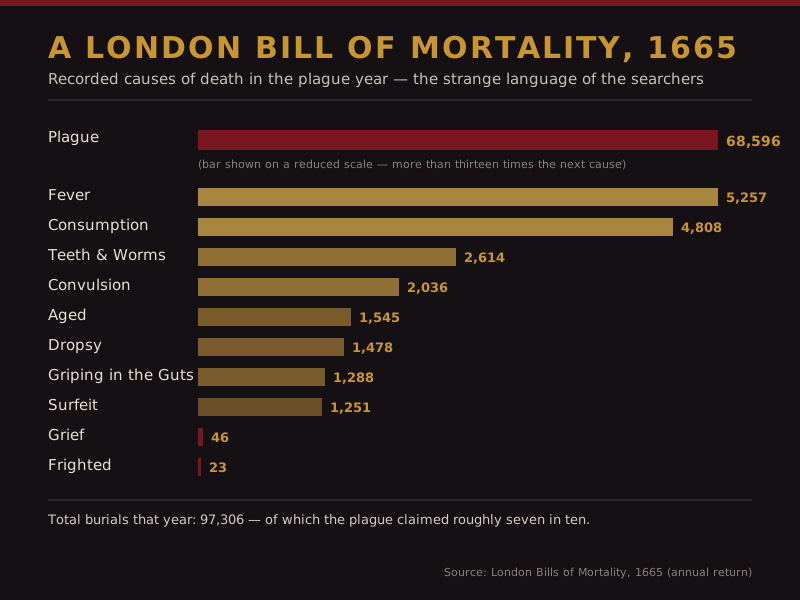
The consequences reached far beyond the immediate horror. The sudden scarcity of labour is widely argued to have strengthened the bargaining position of surviving workers and to have contributed, over the long term, to the erosion of the feudal order in parts of Europe. The catastrophe left deep marks on religion, art and psychology — the danse macabre itself is often understood as one cultural response to a world in which death had become both omnipresent and arbitrary. Later outbreaks, including the plague that struck London in the seventeenth century, kept the memory raw for generations. The study of these events is a sobering reminder that mortality is not only a private matter but a force capable of transforming economies, faiths and whole ways of life.
For much of the twentieth century, at least in many Western societies, death receded from everyday view. Dying increasingly happened in hospitals rather than at home, undertaking became a specialised profession, and open conversation about mortality grew rare. In recent decades, a countercurrent has emerged, often described as the death-positive movement. Its premise is not a celebration of death but the conviction that avoiding all thought of it makes people less prepared, more fearful and less able to grieve well.
The movement takes many forms. “Death cafés” — informal gatherings where people meet to discuss mortality over tea and cake — have spread across many countries. Advocates encourage people to think in advance about their wishes for the end of life and to reclaim a more active role in caring for their own dead. There is renewed interest in environmentally gentler alternatives to conventional burial and cremation, and a broader effort to make grief speakable again. In many ways the movement is less an innovation than a rediscovery, reaching back toward the frankness about mortality that earlier eras — the age of memento mori and the danse macabre — took for granted. Its central claim is a quiet one: that to remember death is not to be morbid, but to be more fully awake to life.
Taken together, these threads — the art, the architecture of bone, the customs, the science, the catastrophes and the contemporary reckoning — trace a single, continuous human effort. It is the effort to make meaning out of the one certainty every person shares. The dead cannot speak for themselves, and so how the living treat them, remember them and think about them becomes a mirror held up to the living. Read carefully, that mirror shows not gloom but something closer to the whole shape of a life: finite, fragile, and for exactly those reasons, worth attending to with care.
Most of these sites are open to visitors precisely because their creators intended the dead to instruct and move the living. Visiting with genuine reflection, observing posted rules, refraining from touching remains, and being mindful that these are real human beings — not props — is entirely in keeping with the spirit in which places such as Sedlec, the Paris Catacombs and the Capuchin Crypt were made. Casual irreverence or disruptive photography is where respect breaks down.
In an era of high mortality and expensive, scarce photography, a post-mortem portrait was often the only image a family would ever have of a loved one, particularly a child. The practice was an expression of grief and devotion rather than morbidity. Understood in its own context, it belongs to the same human impulse as keeping a lock of hair or a treasured letter — the wish to preserve some tangible trace of a person who can no longer be seen.
A body farm is a research facility where donated human remains are allowed to decompose under studied conditions, advancing the forensic science of taphonomy. The remains are gifts from individuals who chose to donate their bodies to science, and they are handled with strict protocols and respect. The knowledge produced helps investigators establish how and when a person died, with real consequences for justice, which is why the field is widely regarded as both ethical and valuable.
Beyond its immense death toll — estimates vary but often fall between roughly a third and a half of Europe’s population — the pandemic had lasting social effects. The resulting scarcity of labour is widely thought to have improved conditions for surviving workers and contributed over time to the weakening of feudal structures in some regions. It also left profound marks on religion, art and the collective psyche, informing themes such as the danse macabre.
Despite its name, the movement does not celebrate death. It argues that openly acknowledging mortality — through candid conversation, advance planning, and a more hands-on relationship with dying and grief — leaves people better prepared and less fearful than avoidance does. In practice this includes death cafés, interest in gentler alternatives to conventional burial, and efforts to make grief speakable again. In many respects it revives an older, franker attitude toward mortality.
2026/07/07
Beneath a small chapel in the Czech town of Kutná Hora, the bones of tens of thousands are arranged into chandeliers, garlands…
 2026/06/27
For centuries the man who cut your hair also bled you, pulled teeth and set bones.