The Bone Chapel of Sedlec: A Church Built From 40,000 Dead
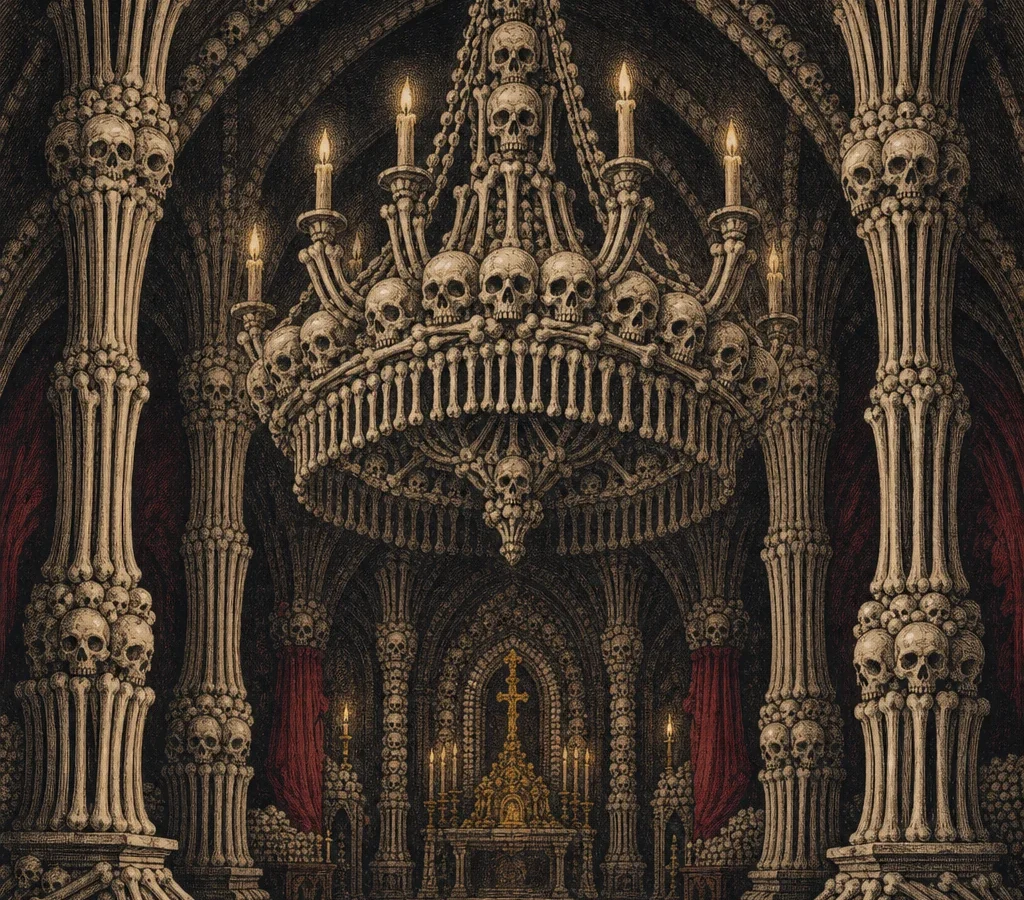
Beneath a modest Gothic chapel on the outskirts of Kutná Hora, in the Bohemian heartland of the Czech Republic, lies one of the most disquieting works of devotional art in Europe. The Sedlec Ossuary — the Kostnice v Sedlci — is a small subterranean space, no larger than an ordinary parish chapel, and yet it is furnished almost entirely with human bone. Skulls sit in tidy pyramids. Femurs are strung in swags like garlands. A great chandelier hangs from the vaulted ceiling, and it is said to incorporate at least one of every bone in the human body. The remains of an estimated 40,000 to 70,000 people are arranged here, and the effect on visitors is rarely what one might expect. The place is quiet, careful, and strangely serene.
To understand how such a thing came to be, one has to begin not with morbidity but with soil — and with a single abbot’s journey to the Holy Land.
A Pinch of Holy Earth
In 1278, Henry, the abbot of the Cistercian monastery at Sedlec, was sent on a diplomatic mission to the Kingdom of Jerusalem by the Bohemian king Otakar II. He returned carrying a small quantity of earth said to have been taken from Golgotha, the hill of the Crucifixion. Henry scattered this consecrated soil across the monastery’s cemetery. The gesture transformed an ordinary graveyard into something extraordinary: a piece of the Holy Land transplanted into Central Europe.
Word spread, and the cemetery at Sedlec became one of the most desirable burial grounds in the region. To be interred there was, in the medieval imagination, to be buried in sacred ground of the highest order. People arranged to have their bodies — and the bodies of their kin — brought to Sedlec from across Bohemia and beyond. The demand would prove, in time, to be more than the small plot could bear.
Plague, War, and an Overflowing Ground
Two catastrophes filled the cemetery beyond capacity. The first was the Black Death, which swept through Bohemia in the mid-fourteenth century and killed a vast portion of the population. Contemporary and later accounts suggest that many thousands were buried at Sedlec during the pandemic years alone. The second was the Hussite Wars of the early fifteenth century, the religious conflict that convulsed the Czech lands after the execution of the reformer Jan Hus. Fighting around Kutná Hora added further dead to the ground.
By this point the cemetery simply could not hold everyone who had been promised, or who had paid, for a place in its holy soil. A Gothic church was built on the site around 1400, with a vaulted lower chapel. The practical solution to overcrowding was the one adopted across much of medieval Europe: older graves were exhumed to make room for the newly dead, and the disinterred bones were gathered and stored. That lower chapel became an ossuary — a house of bones — and over the following centuries the remains accumulated into enormous heaps.
The Half-Blind Monk and the Woodcarver
According to tradition, the first attempt to order the mounting chaos of bones came around 1511, when a half-blind monk was given the task of stacking the remains. He is credited with building the first bone pyramids. For the next several centuries the ossuary remained a place of stored bones, growing steadily as the graveyard above continued to be cleared.
The chapel and the surrounding lands eventually passed to the aristocratic Schwarzenberg family, who in 1870 commissioned a woodcarver named František Rint to bring order to the disordered heaps. Rint’s response was audacious. Rather than merely stacking the bones neatly, he set out to compose with them. He cleaned and, by some accounts, bleached the remains, and then arranged them into an interior of extraordinary and deliberate craftsmanship.
The centerpiece of Rint’s work is the great chandelier that hangs at the center of the chapel. It is a genuine feat of macabre design, incorporating skulls, jawbones, pelvises, and long bones into a form that would not look out of place, in silhouette, in any grand hall. Alongside it Rint fashioned four towering bone pyramids in the corners, festoons of skulls draped along the vaulting, and monstrances shaped from bone. He also rendered the Schwarzenberg family coat of arms entirely in human remains — including, in one grim flourish, a bird pecking at the eye socket of a Turkish skull, a heraldic reference to the family’s military history.
Rint left one final touch. Near the entrance, worked in bone against the wall, is his own signature and the date 1870 — an artist claiming a work made not of stone or wood but of the dead themselves.
A Meditation, Not a Spectacle
It would be easy to read Sedlec as pure Gothic theatre, and modern film and photography have often framed it that way. But the ossuary belongs to a long Christian tradition of the memento mori — the reminder that death comes for all, that earthly rank and beauty are fleeting, and that the living would do well to contemplate their end. The bones of the anonymous poor and, quite possibly, the once-powerful rest together here without distinction. A prince and a plague victim are indistinguishable once reduced to the same pale architecture.
In recent years the chapel’s custodians have restricted photography and worked to restore the fragile arrangements, some of which had begun to deteriorate. There has also been a renewed emphasis on treating the site as a place of remembrance rather than a curiosity. These are, after all, real people — men, women, and children who died of plague, of war, and of the ordinary attrition of medieval life, and who were promised nothing more than rest in holy ground.
For readers drawn to the ways human cultures have confronted mortality, the Sedlec Ossuary sits within a broader tradition explored throughout our writing on death and disfigurement — a reminder that the boundary between reverence and the macabre has always been thinner, and more thoughtfully drawn, than we tend to assume.
Today Sedlec draws hundreds of thousands of visitors a year, and it remains a consecrated space. Whatever one makes of Rint’s chandelier, it endures as a singular answer to a very old question: what is to be done with the dead when the earth itself has run out of room? At Sedlec, the answer was to make of them something that would outlast the living who came to look.