The Codex Gigas
 2026/07/04
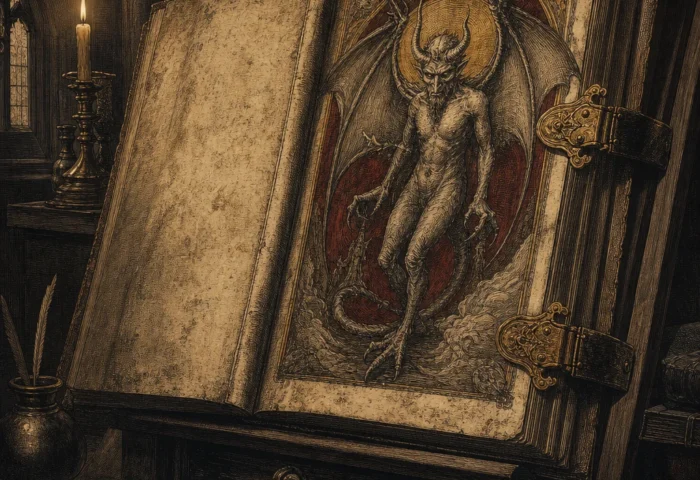
A medieval manuscript so large it needed animal skins by the herd, and a legend of a pact.

Every culture keeps a drawer of things it cannot quite explain. Ours is larger than most, and better documented — which means that when a strange story surfaces today, the honest response is neither breathless belief nor reflexive dismissal, but a slower and more interesting question: what actually happened here, what do we genuinely know, and where does the record run out? This section is built around that question. It treats the world’s famous anomalies as puzzles rather than proofs, and it takes the position — cheerfully, and without apology — that reality is peculiar enough on its own terms that it rarely needs help.
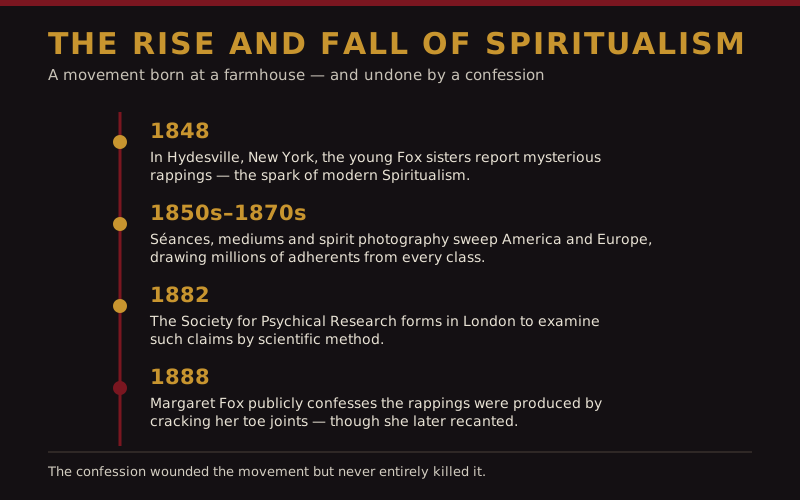
What follows is a guided tour through some of the most enduring unexplained events, alongside the far less glamorous but far more useful explanations that account for most of them: crowd psychology, the quirks of human perception, the folklore machine, and the sheer volume of hoaxes and honest mistakes in the historical record. A small residue survives all of this scrutiny and remains genuinely open. Those cases, it turns out, are the ones worth loving.
The temptation with a good mystery is to reach for the most dramatic explanation first. The discipline is to reach for it last. Consider a handful of the classics — each one real, each one documented, and each one far more nuanced than its campfire version.
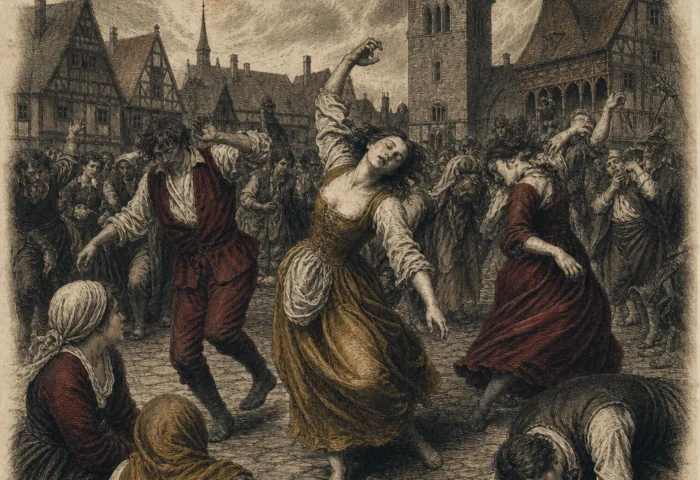
In the summer of 1518, in Strasbourg, a woman began to dance in the street and did not stop. Within weeks, contemporary accounts describe dozens and then reportedly hundreds of people caught up in the same compulsion, some dancing to exhaustion, injury, or collapse. This is not folklore invented centuries later; it appears in municipal records, physician notes, and chronicles of the period. The city authorities, in a decision that reads as darkly comic today, initially concluded that more dancing was the cure and arranged for musicians and space.
What caused it remains debated. The leading explanations point to mass psychogenic illness under conditions of extreme stress — famine, disease, and religious dread were all present in Strasbourg that year — possibly amplified by the era’s belief in Saint Vitus, who was thought to be able to inflict compulsive dancing as a curse. A once-popular idea that ergot poisoning from moldy rye was responsible has fallen out of favor, since ergotism tends to produce convulsions and constricted blood flow rather than sustained, coordinated movement. The event is explored at greater length in the study of the Dancing Plague, but the short version is instructive: a thoroughly documented, thoroughly bizarre event, most plausibly explained not by the supernatural but by the mind’s capacity to spread a behavior through a frightened population.
On the morning of 30 June 1908, an enormous explosion flattened an estimated 2,000 square kilometers of remote Siberian forest near the Podkamennaya Tunguska River — roughly 80 million trees knocked down in a radial pattern. The blast was registered on barometers as far away as Britain, and the skies over Europe and Asia glowed for nights afterward. Remarkably, because the region was so sparsely populated, there are no confirmed direct fatalities.
Here the mystery is genuine but bounded. The overwhelming scientific consensus is that the Tunguska event was an airburst — the atmospheric explosion of an incoming asteroid or comet fragment, perhaps 50 to 60 meters across, that disintegrated several kilometers above the ground rather than striking it. That is why no substantial impact crater was ever found, a fact that fueled decades of more exotic speculation. The absence of a crater is not a puzzle; it is exactly what an airburst predicts. What remains legitimately open is the precise nature and composition of the object. That is a real scientific question, and a considerably more sober one than the antimatter and spacecraft theories it has attracted.
In February 1959, nine experienced ski hikers died in the northern Ural Mountains under circumstances that have generated speculation ever since. Their tent was found cut open from the inside; the group had fled into lethal cold, some inadequately dressed, and several bodies showed severe injuries. Soviet-era secrecy and a vague official conclusion citing a “compelling natural force” left a vacuum that filled quickly with theories ranging from military testing to the supernatural.
More recent work has narrowed the field considerably. A 2021 study using avalanche modeling and, notably, techniques informed by automotive crash simulation proposed that a delayed slab avalanche on the modest slope above the tent was physically plausible and could account for both the sudden nighttime evacuation and the pattern of blunt-force injuries. This is not certainty — the terrain and timeline still leave room for argument — but it is a reminder that “unexplained” often means “not yet examined with the right tools,” rather than “beyond explanation.” The Dyatlov case sits in an honest middle ground: much better understood than the legend suggests, not quite fully closed.
The Mary Celeste was found adrift in the Atlantic in December 1872, seaworthy, provisioned, and entirely deserted; her crew and the captain’s family were never seen again. It is the archetypal “ghost ship,” and centuries of retelling have layered it with embellishments — meals left steaming on the table, an untouched breakfast — that appear nowhere in the original accounts and almost certainly never happened.
The documented facts are stranger for being sparser. The ship’s lifeboat was missing, suggesting a deliberate, orderly abandonment rather than a violent one. Leading explanations involve some feared catastrophe that turned out to be survivable: a possible discharge of alcohol vapor from the cargo of industrial ethanol, a faulty pump reading that made the crew overestimate flooding, or fear of imminent sinking that prompted them to take to the boat — which was then lost. No single theory is proven. But the case illustrates a recurring pattern: the true mystery is modest and maritime, while the famous mystery is a fiction assembled from later additions.
Few claims are as lurid as spontaneous human combustion — the idea that a body can, without external ignition, burst into flame and be almost entirely consumed while surroundings remain relatively untouched. It is worth stating plainly: there is no credible scientific evidence that human bodies ignite spontaneously. What the documented cases tend to share is far more prosaic and far more grim. Most involve an external ignition source, often a cigarette, an open flame, or an ember; a victim who is elderly, incapacitated, intoxicated, or otherwise unable to respond; and the so-called wick effect, in which clothing acts like a candle wick and the body’s own fat becomes fuel, sustaining a slow, contained, intensely localized burn over hours. The eerie result — a largely consumed body beside undamaged furniture — is a physical consequence, not a paranormal one. This is a case where “unexplained” has, on close inspection, a well-understood chemistry.
The Dancing Plague is the spectacular ancestor of a phenomenon that never really went away. Mass psychogenic illness — the rapid spread of symptoms with no identifiable physical cause through a group under stress — is one of the most reliably underrated explanations for events that get filed under “anomaly.” It is not a moral failing and not fakery; it is a genuine physiological response to social and psychological pressure. People really do feel ill, faint, twitch, or convulse.
The pattern recurs with striking consistency across centuries and settings: convent outbreaks in medieval and early-modern Europe; the fainting and nausea that sweep through schools and factories; contemporary episodes spread partly through media and social networks, where the “exposure” is information rather than any physical agent. The tells are recognizable — symptoms that move along lines of sight and social connection, that cluster in high-anxiety environments, that resist any medical explanation, and that resolve once the perceived threat is addressed. Recognizing this does not diminish the people involved. It relocates the mystery from the paranormal to the social, which is arguably a more unsettling place to find it.
The single most productive move in the study of the strange is to turn the lens around. Instead of asking what is out there, ask what the perceiving brain is doing. Human perception is not a camera; it is a prediction engine, evolved to find pattern and agency quickly, because a false alarm is cheaper than a missed predator. That deep bias produces a reliable catalogue of “hauntings” that have nothing to do with the dead.
Pareidolia is the tendency to see meaningful forms — especially faces — in random stimuli: the face in a scorched piece of toast, the figure in a shadowed doorway, the profile in cliff rock. It is not a defect; it is a hair-trigger face-detection system doing precisely what it evolved to do. Apophenia is its broader cousin: the perception of meaningful connections between unrelated things, the engine behind conspiracy thinking and “too many coincidences to be chance.” Both are universal, both are involuntary, and both are wonderful — right up until they are mistaken for evidence.
Sound below the threshold of conscious hearing, roughly under 20 hertz, can be produced by wind over structures, machinery, and some natural sources. Research has suggested that infrasound may induce feelings of unease, anxiety, chills, and a sense of a “presence” in some people, and there are documented cases — most famously a laboratory investigation into an allegedly haunted space — where a low-frequency standing wave correlated with reports of dread. The evidence is suggestive rather than airtight, and it should be cited with appropriate care. But it offers a physical mechanism for the classic haunted-room experience that does not require anything to be in the room at all.
Perhaps the most consequential single explanation for encounters with entities is sleep paralysis. During REM sleep the body is naturally immobilized; occasionally a person wakes while that paralysis persists and while dream imagery bleeds into waking perception. The result is textbook and terrifying: an inability to move, a crushing weight on the chest, and a vivid sense of a malevolent presence in the room. Cultures worldwide have named the intruder — the Old Hag, the incubus, shadow figures, and in some modern accounts, alien visitors. The experience is real, the terror is real, and the mechanism is thoroughly documented neurology. It is one of the clearest examples of how a single physiological event can generate an entire genre of supernatural report.
Cryptids — creatures whose existence is claimed but unconfirmed — are a natural experiment in how folklore forms. Watching one assemble in real time is genuinely illuminating, because the ingredients are almost always the same.
The Loch Ness Monster is instructive precisely because it has been searched for so exhaustively. Sonar surveys and, more recently, environmental DNA sampling of the loch’s water have turned up no evidence of any large unknown creature — though the eDNA work notably registered a great deal of eel DNA, which is at least a charming candidate for some sightings. The most iconic “surgeon’s photograph” from 1934 was decades later described as a staged hoax involving a model. None of this makes the phenomenon uninteresting. It makes it a case study in how a landscape, a legend, and a hunger for wonder combine to keep a creature alive without a single confirmed specimen. For more curiosities that live at this border between the real and the imagined, the the Cabinet of Curiosities is the appropriate rabbit hole.
Any honest survey of the anomalous has to confront an uncomfortable proportion: most of the record is contaminated. Not by the paranormal, but by two ordinary human tendencies — the urge to deceive and the ease of being wrong.
The history of the strange is thick with confessed fabrications. The Cottingley Fairies, photographs that briefly convinced the creator of Sherlock Holmes, were eventually admitted by the two girls involved to be cutouts. The crop-circle phenomenon, once treated as evidence of everything from plasma vortices to visitors, was substantially deflated when two Englishmen revealed in 1991 that they had spent years making formations with planks and rope — after which the designs, tellingly, grew more elaborate and more artistic. Hoaxes persist because they are rewarded: with attention, with money, and sometimes simply with the private satisfaction of fooling the credulous.
Even without a single liar, the record would be crowded with error. The sky is full of things people rarely look at carefully: the planet Venus, which is a perennial and unglamorous source of “UFO” reports; lenticular clouds; satellites and, increasingly, satellite constellations; ball lightning; sundogs and other atmospheric optics; and the entire zoo of visual and cognitive illusions the brain runs by default. A meaningful fraction of anomalous reports dissolve the moment a mundane and specific cause is identified. This is not condescension toward witnesses. Sincere, intelligent, sober people misperceive constantly, because misperception is a standard feature of a nervous system optimized for speed rather than accuracy.
After the crowd psychology, the perceptual science, the folklore analysis, and the mountain of hoaxes and mistakes have been subtracted, something small and stubborn is left over. Not a monster, not a ghost, not a proof of anything — but a set of cases and questions that resist tidy closure and remain, in the proper sense, unexplained.
Some of the residue is scientific in the ordinary way: the exact composition of the Tunguska object; the precise sequence of events at Dyatlov Pass; the specific fate of the Mary Celeste’s crew. These are answerable in principle, awaiting only better evidence. Some of it lives at the edges of legitimate inquiry — anomalous perceptual reports that don’t fully reduce to known mechanisms, patterns in eyewitness data that merit study rather than mockery. And some of it is simply the acknowledgment that a universe this large, this old, and this indifferent to human convenience will always contain events for which we lack the vantage point to explain.
The correct posture toward that residue is not belief and not contempt. It is patience. The history of science is, among other things, a history of former anomalies — meteorites, once dismissed as peasant superstition; germs; continental drift — that turned out to be real once the tools and the humility caught up. The lesson is not that everything strange is true. The vast majority is not. The lesson is that the boundary between the explained and the unexplained is a working front line, not a fortress wall, and that intellectual honesty means holding it without pretending it is somewhere it is not.
That is the through-line of everything gathered here, and of the material in Halloween & Horror and the darker holdings such as the Codex Gigas: the world is strange enough without embellishment. The dancing really happened. The forest really fell. The ship was really empty. And the best mysteries are the honest ones — the ones you can look at directly, in good light, and still not fully explain.
Rarely, and usually the reverse. An explanation typically relocates the wonder rather than removing it. Understanding sleep paralysis, for instance, reveals that a single neurological event has generated near-identical “night visitor” encounters across every culture on Earth — which is more remarkable, not less, than a one-off ghost. The mundane cause is often the more astonishing story once you follow it through.
Yes. It appears in municipal records, physician accounts, and chronicles from Strasbourg. Dozens of people were reportedly affected, some to the point of collapse. The leading explanation is mass psychogenic illness under conditions of severe stress, possibly shaped by contemporary beliefs about Saint Vitus. The older ergot-poisoning theory is now generally considered unlikely.
There is no credible scientific evidence that human bodies ignite without an external source. The documented cases are consistent with an outside ignition — often a cigarette or open flame — combined with a victim unable to respond and the “wick effect,” in which clothing and body fat sustain a slow, localized burn. It is a grim but well-understood process, not a paranormal one.
The scientific consensus is an airburst: an incoming asteroid or comet fragment exploded several kilometers above the Siberian forest in 1908, flattening a vast area without leaving a substantial impact crater. The lack of a crater is exactly what an airburst predicts. The main open question is the precise nature and composition of the object, which is a legitimate scientific puzzle rather than an unexplained one.
Because we largely share the same perceptual hardware. Pareidolia produces faces in randomness, sleep paralysis produces a sensed “presence” and chest pressure, infrasound may induce unease, and cultural templates shape what people expect to see. Shared biology and shared stories together explain why encounters cluster around a handful of recurring forms across very different times and places.
2026/07/04
A medieval manuscript so large it needed animal skins by the herd, and a legend of a pact.
 2026/06/25
In the summer of 1518, hundreds of people in Strasbourg danced without rest for days. Some collapsed; contemporary accounts say a number…