The Dancing Plague of 1518: When a City Danced Itself to Death
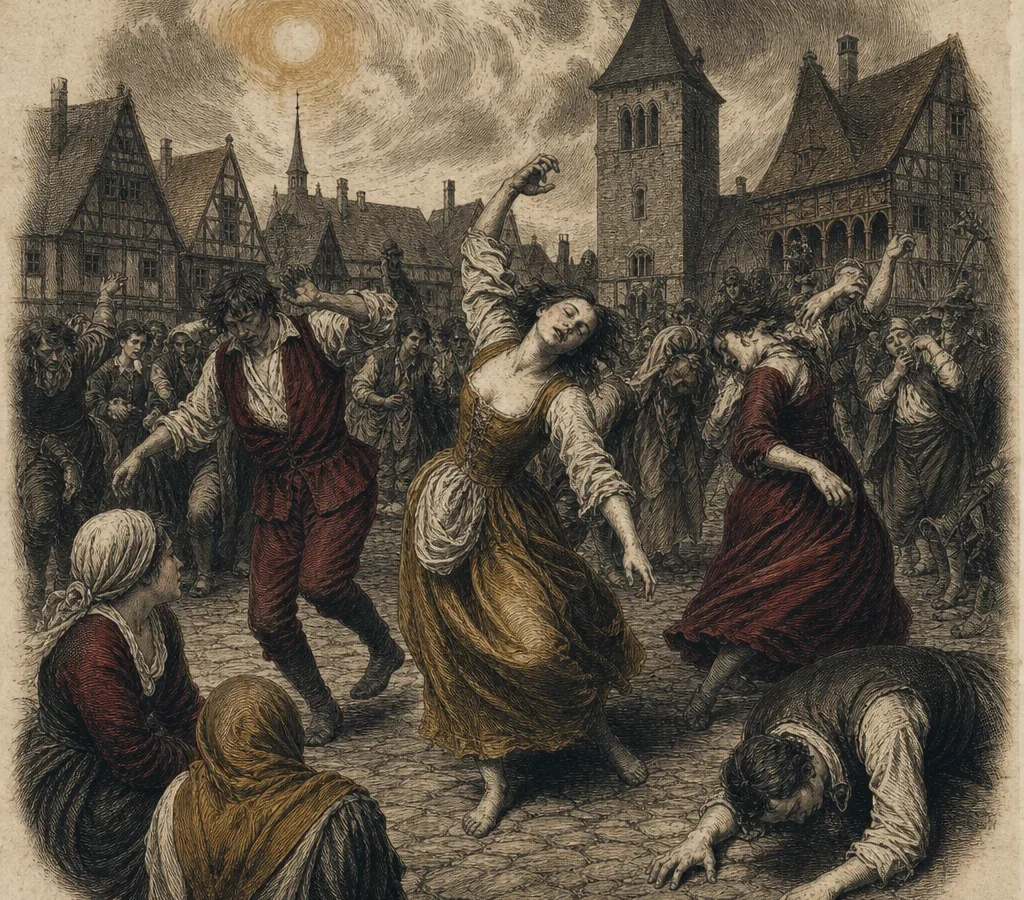
In the sweltering July of 1518, in the free imperial city of Strasbourg, a woman stepped into a narrow street and began to dance. There was no music, no festival, no evident reason. She simply danced — fervently, exhaustingly, without pause — and she did not stop. Her name, recorded in later accounts, was Frau Troffea, and within a week some three dozen of her neighbours had joined her. Within a month the number is said to have swelled toward four hundred. Some of them, according to the chronicles, danced until they collapsed, and a number are reported to have died.
The Dancing Plague of 1518 is among the best-documented episodes of collective, involuntary behaviour in European history. It is not a folk tale embroidered by later centuries but an event attested by municipal records, physicians’ notes, and contemporary chronicles. And yet, five hundred years later, no one can say with certainty what caused it.
What the Records Actually Say
Strasbourg in 1518 was a prosperous but strained city. The surviving documentation — including notes from the city council, sermons, and the writings of the physician and alchemist Paracelsus, who visited the region some years afterward and commented on the affair — describes a phenomenon that spread person to person over the summer weeks. The dancers were not celebrating. Observers recorded expressions of fear and distress, not joy. Many appeared to dance against their own will, unable to stop even as their feet blistered and their bodies failed.
The city authorities were baffled, and their response tells us a great deal about how the crisis was understood at the time. Rather than restraining the afflicted, the councillors and their appointed physicians initially concluded that the dancing was a natural affliction — an excess of “hot blood” — that could only be cured by allowing the sufferers to dance it out of their systems. To that end, the city cleared guild halls and market spaces, hired musicians, and even engaged professional dancers to accompany the afflicted. The intention was therapeutic. The effect, if the accounts are accurate, was to prolong and intensify the outbreak.
Eventually the authorities reversed course. As the death toll mounted and the “dance it out” strategy visibly failed, the dancers were removed from public view and taken to a shrine dedicated to Saint Vitus in the mountains above the city, where they were led through rituals of penance and prayer. The outbreak subsided over the following weeks — though whether the shrine, the changing weather, or simple exhaustion brought it to an end is impossible to know.
The Ergot Hypothesis
The most frequently cited biological explanation points to ergot, a fungus (Claviceps purpurea) that grows on damp rye and other cereals. Ergot contains alkaloids chemically related to LSD, and ergot poisoning — known historically as St. Anthony’s Fire — can produce hallucinations, convulsions, burning sensations, and altered states of mind. Because Strasbourg had endured poor harvests and famine in the preceding years, the population may well have been eating contaminated grain.
The theory is appealing, but it has serious weaknesses. Ergot poisoning typically produces violent convulsions and constricts blood flow to the extremities, often causing gangrene — outcomes hard to reconcile with sustained, coordinated dancing over days and weeks. Critics, notably the historian John Waller, have argued that ergotism simply does not explain the specific behaviour described: people who danced, in relatively organised fashion, for extended periods, rather than convulsing or losing the use of their limbs. Poisoning of that severity would more likely leave victims incapacitated than in motion.
Mass Psychogenic Illness
The explanation now favoured by many historians is that the Dancing Plague was an instance of mass psychogenic illness — sometimes called mass hysteria — in which extreme psychological distress manifests as involuntary physical symptoms that spread through a population by suggestion. The conditions in Strasbourg were extraordinarily grim. The preceding years had brought famine, disease including smallpox and syphilis, brutal cold, and crushing economic hardship. The population was frightened, hungry, and exhausted.
Crucially, the region also carried a specific cultural belief that made dancing a plausible form for distress to take. Saint Vitus was popularly associated with the power to inflict — or cure — compulsive dancing. In a society steeped in the fear of divine punishment, a rumour or example of cursed dancing could act as a kind of psychological trigger, especially among people already pushed to the edge of endurance. Waller has argued that the affliction spread through a combination of this shared belief and a state of trance made possible by severe stress. Once Frau Troffea began, the cultural script for what was happening was already written, and the terrified could fall into it.
Mass psychogenic illness is not a relic of the credulous past. Documented modern episodes — outbreaks of fainting, twitching, or uncontrollable laughter in schools and factories — follow a recognisable pattern: a stressed, tightly-knit group, a triggering event, and symptoms that spread by observation. What differs across centuries is the form the symptoms take, and the form is shaped by what a community already fears and believes.
A Human Catastrophe, Not a Curiosity
Whatever its cause, the episode belongs to the long and sobering record of the ways human bodies fail and human minds break under pressure — a subject examined across our writing on death and disfigurement. It is tempting to treat the Dancing Plague as an amusing oddity, a footnote of medieval strangeness. But the sources describe genuine suffering: people who could not stop, who watched their neighbours collapse, and who danced through a summer of famine toward, in some cases, their own deaths.
The most honest conclusion is that the Dancing Plague of 1518 remains genuinely unexplained. The ergot theory is probably insufficient; mass psychogenic illness is the best-supported framework but cannot be proven at a distance of five centuries. What the records preserve with certainty is the sheer strangeness of the human animal under duress — a city that met catastrophe not with panic or violence but with a dance it could not end, and could not, at first, even understand as a catastrophe at all.