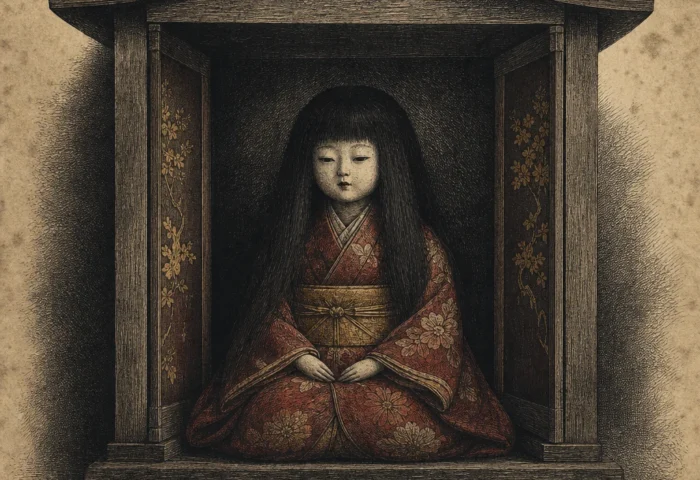
The Watching Doll of Okiku
 2026/06/30
A doll in a Hokkaido temple whose hair, keepers say, does not stop growing.

Every year, as October thins toward its close, something ancient stirs beneath the plastic skeletons and the bags of miniature chocolate bars. The costumes, the carved gourds glowing on porch steps, the delicious dread of a good ghost story — none of it arrived by accident. Behind the modern spectacle lies a tangle of Celtic fire festivals, Christian holy days, immigrant improvisation, and the strange, durable human appetite for being frightened on purpose. Halloween is one of the oldest surviving conversations between the living and the dead, dressed up now in nylon and marketing.
What follows is a wander through that conversation: where the night truly came from, why a mischievous Irishman is trapped inside every lantern, how horror grew from graveyard poetry into a global film industry, and why so many people happily pay good money to be terrified. Some of it is documented history. Much of it is folklore — and where the two part ways, this magazine says so plainly.
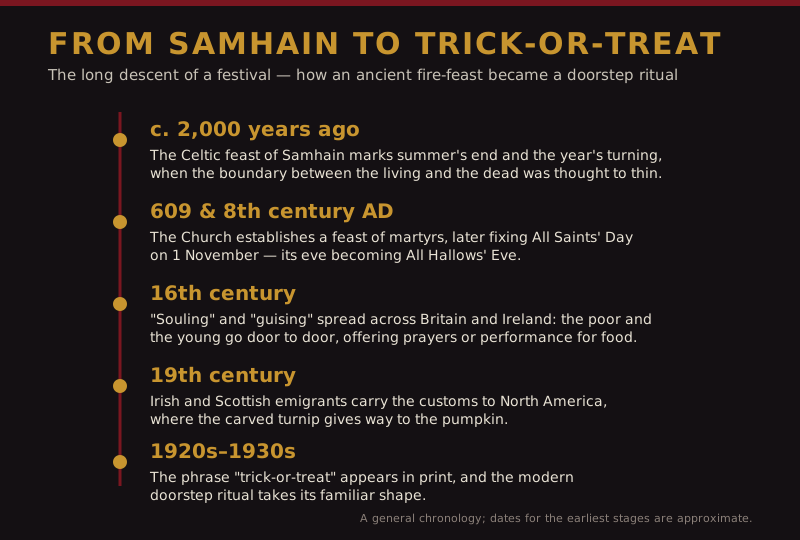
The story most often told begins with Samhain (pronounced roughly SAH-win), the festival marking the end of the Celtic harvest and the onset of winter’s dark half. Observed across Ireland, Scotland, and the Isle of Man around the start of November, Samhain was one of the great quarter-days of the Gaelic year. The historical record here is genuinely old: medieval Irish literature, including tales set at the royal site of Tara, treats Samhain as a moment of consequence, a threshold when the ordinary rules of the world grew thin.
Folk tradition held that on this night the boundary between the living world and the Aos Sí — the spirits and fairy folk — became permeable. Offerings of food and drink were left out; hearth fires were tended or ceremonially rekindled; people are said to have disguised themselves, possibly to move safely among wandering spirits or to impersonate them. It is tempting, and common, to draw a straight line from these disguises to the modern trick-or-treater. Historians are more cautious. The evidence for specific Samhain customs is patchy and often recorded centuries later, so the honest position is that Samhain supplied the season and the mood of Halloween, while the precise rituals of the ancient Celts remain partly reconstructed rather than fully documented.
The other parent of Halloween is Christian. By the eighth and ninth centuries the Western Church had settled the feast of All Saints — All Hallows — on the first of November, followed by All Souls’ Day on the second, a time to honour the saints and pray for the dead. The evening before All Hallows became “All Hallows’ Eve,” which contracted over time into “Hallowe’en.” Whether the Church deliberately placed these feasts to overlay an existing pagan season, or the dates converged for other reasons, is debated among scholars; both threads, Gaelic and Christian, plainly braided together in the British Isles.
Out of that braid came practices with better documentation. “Souling,” recorded in England and elsewhere, saw the poor go door to door offering prayers for the dead in exchange for “soul cakes.” “Guising” in Scotland and Ireland had costumed youngsters perform a song, rhyme, or trick to earn food or coins. These are the credible ancestors of trick-or-treating — a custom of exchange, not extortion.
Halloween came to North America largely with Irish and Scottish immigrants in the nineteenth century, particularly in the wake of the Great Famine. There it mingled with other harvest and autumn customs and slowly shed its explicitly religious character. By the early twentieth century American communities were working hard to tame the night’s rowdier pranking into something wholesome and neighbourly. Trick-or-treating as a coordinated, candy-based ritual became widespread only around the mid-twentieth century, after which the confectionery and costume industries recognised a spectacular opportunity. The modern result is a holiday that is simultaneously very old and thoroughly commercial — a Celtic ember fanned into a retail bonfire.
Few objects say “Halloween” as instantly as a candle guttering inside a carved face. The name and the legend behind it come from Irish and Scottish folklore, and the star of the story is not a pumpkin at all.
As the folktale goes, a drunkard and trickster known as Stingy Jack managed to outwit the Devil — in various tellings by trapping him up a tree marked with a cross, or by pinning him with a crafty bargain — and extracted a promise that his soul would never be claimed for Hell. When Jack eventually died, Heaven would not have such a scoundrel, and the Devil, bound by his word, would not take him either. Condemned to wander the darkness, Jack was tossed a single burning coal, which he placed inside a hollowed-out turnip to light his endless road. He became “Jack of the Lantern” — Jack-o’-lantern — a restless light glimpsed on the moors and in the marshes.
It is worth noting that “jack-o’-lantern” was also an old name for the eerie, drifting lights over bogland that folklore populated with mischievous or damned spirits, a phenomenon elsewhere called will-o’-the-wisp. The lonely wanderer and the marsh-light share a name for good reason: both are lights that lead you nowhere good.
The genuinely well-attested detail here is the vegetable. In Ireland and Scotland people carved lanterns from turnips, and sometimes beets or large potatoes, hollowing them out and cutting grotesque faces to ward off Stingy Jack and other wandering spirits — or simply to delight and frighten the neighbours. Surviving examples of these turnip lanterns are, frankly, more nightmarish than any pumpkin: gnarled, snaggle-toothed, and distinctly unfriendly.
The pumpkin is America’s contribution. When the tradition crossed the Atlantic, immigrants found the native pumpkin plentiful, larger, and far easier to carve than a stubborn turnip. The switch was practical, and the pumpkin’s cheerful orange bulk has ruled the porch ever since. Those drawn to the odder relics of belief and craft will find kindred spirits in the Cabinet of Curiosities, where the handmade and the uncanny keep close company.
Fear-as-entertainment did not begin with cinema. It has a literary pedigree that runs straight through some of the most influential writing in the English language.
The horror novel as a recognisable form is usually traced to 1764 and Horace Walpole’s The Castle of Otranto, which announced the machinery of the Gothic: crumbling castles, buried secrets, ancestral curses, and an atmosphere thick with dread. The mode flourished across the following decades in the hands of writers such as Ann Radcliffe, whose novels perfected the art of suspense and the terror that is eventually explained, and Matthew Lewis, whose The Monk pushed toward genuine horror and scandal.
Two Gothic offspring outgrew the genre entirely. Mary Shelley’s Frankenstein; or, The Modern Prometheus (1818), written when its author was still in her late teens, fused Gothic dread with the anxieties of a scientific age and is often cited as a founding text of science fiction as much as of horror. Decades later, Bram Stoker’s Dracula (1897) gathered scattered vampire folklore into the definitive literary vampire, an aristocratic predator that has haunted the imagination ever since.
In America, Edgar Allan Poe gave horror its interior architecture. In the 1830s and 1840s his tales of premature burial, murderous guilt, and psychological collapse — “The Tell-Tale Heart,” “The Fall of the House of Usher,” “The Masque of the Red Death” — demonstrated that the most frightening rooms are inside the skull. Poe also effectively invented the modern detective story, but it is his atmosphere of beautiful morbidity that still defines a certain kind of dark taste.
Meanwhile the appetite for cheap thrills fed the “penny dreadfuls,” lurid serialised fiction sold to a mass Victorian readership. They gave the world enduring figures such as Sweeney Todd, the murderous barber, and the vampire Varney, and they proved that horror could be popular entertainment for everyone, not just a literary elite. For a wider sweep of the strange and inexplicable that has always drawn writers to the dark, see Paranormal Anomalies.
Cinema seized on this inheritance almost at once. Early landmarks include the German Expressionist films of the silent era — The Cabinet of Dr. Caligari (1920) and Nosferatu (1922), the latter an unauthorised riff on Dracula whose distributor was famously sued by Stoker’s widow. But the genre’s popular explosion came in the 1930s at Universal Pictures, whose run of monster films — Dracula and Frankenstein in 1931, followed by The Mummy, The Invisible Man, and later The Wolf Man — turned Bela Lugosi and Boris Karloff into icons and fixed the visual grammar of the movie monster for generations.
Horror has reinvented itself in every subsequent era. The atomic anxieties of the 1950s bred giant creatures and alien invaders. Alfred Hitchcock’s Psycho (1960) dragged terror out of the castle and into the ordinary motel. The late 1960s and 1970s brought a darker, more visceral wave — Night of the Living Dead, The Exorcist, The Texas Chain Saw Massacre — and the slasher boom that followed with Halloween (1978) and its many descendants. The genre has since proven endlessly elastic, absorbing social commentary, folk tradition, and psychological realism. Horror endures because it is less a set of monsters than a set of questions about mortality, and those questions never go out of fashion.
The great monsters persist because each one is a folk-answer to a real and frightening question. Strip away the special effects and you often find a community trying to explain death, disease, or the dark.
Long before Stoker’s suave count, vampire beliefs were widespread across Eastern Europe, and they were bound up with the misunderstood realities of death and decomposition. During outbreaks of disease, communities sometimes exhumed suspected “vampires” and found bodies that seemed unnaturally preserved, bloated, or with blood at the mouth — all, we now understand, ordinary features of decomposition that a pre-modern observer read as monstrous life-after-death. There were documented episodes in the eighteenth century, notably in the Habsburg-ruled Balkans, where officials investigated such cases seriously enough that the reports reached learned Europe.
Scholars have often connected vampire panics to epidemic disease: when a contagion spread through a family or village after a death, the first to die could be blamed for “drawing” the others into the grave. The folklore, in other words, was a horrified attempt to explain contagion before germ theory existed. It is a sobering thought that the world’s most glamorous monster began as a way of understanding a plague.
The werewolf — the human who becomes a wolf under the moon — appears in myth and legend across many cultures, from antiquity onward. Belief in shape-shifting men-into-wolves was taken seriously enough in early modern Europe that people were actually tried for lycanthropy during the same period as the witch trials. The legend speaks to an old and universal fear: that beneath the civilised person lies an animal that might, under the right conditions, be loosed.
Ghosts are the most universal monster of all, appearing in virtually every culture and every era, because they answer the most universal fear: what becomes of us, and of those we lose. The details vary enormously — vengeful spirits, sorrowful residents, warnings from beyond — but the underlying idea, that the dead may not be entirely gone, is one humanity seems unwilling to abandon. Some of the most affecting objects said to carry a lingering presence are ordinary and domestic, such as the Okiku doll of Japanese tradition, whose story sits at the tender intersection of grief and the uncanny.
Here is the genuine puzzle at the heart of the whole season: fear is unpleasant, evolution built it to keep us alive, and yet millions of people voluntarily buy tickets to be frightened. Why?
The most widely accepted explanation is that horror offers fear inside a frame of safety. The body’s threat response — racing heart, quickened breath, flood of adrenaline — is genuinely triggered by a good scare, but the rational mind knows the monster is on a screen and the killer cannot reach the seat. That gap between real arousal and real safety is where the pleasure lives. It is often compared to riding a rollercoaster: the plunge is thrilling precisely because you trust the rails.
Psychologists have described a broader tendency, sometimes called “benign masochism,” in which people come to enjoy sensations the body initially reads as threatening once they learn the threat is not real — the burn of chili peppers, the sting of very cold water, the drop of a thrill ride. Horror fits the pattern neatly: the enjoyment comes partly from the mind noticing that it triggered a false alarm and survived. There is also a well-documented “relief” phase, the giddy, almost euphoric release when the tension finally breaks and the lights come up.
Some researchers add that frightening stories may serve as low-stakes rehearsal, letting us imaginatively confront danger, mortality, and the unknown from a position of control. Curiosity plays its part too. A scary tale is a locked room, and the human mind cannot resist a locked room. The same restless fascination draws readers toward accounts of the genuinely unexplained, the sort collected across the pages of this magazine’s paranormal files, where the point is not belief but the pleasure of standing at the edge of what is known.
No tour of the dark curiosities is complete without the haunted place — the house, wood, or castle that “everyone knows” is troubled. These sites are where folklore is most alive, and where the gap between a good story and the documented record is widest. The honest approach is to enjoy the legend while keeping the ledger open.
Many famous hauntings turn out, on inspection, to be layered stories: a real tragedy at the core, embellished by decades of retelling, sometimes amplified by a book or film, and occasionally shaped by outright commercial interest. A location with a genuinely sad history — a battlefield, an asylum, a house where a real crime occurred — provides fertile ground, and the human mind readily fills the shadows with meaning. Investigators note how much of the “evidence” for hauntings dissolves under scrutiny into ordinary causes: settling old buildings, drafts, infrasound, the tricks memory and expectation play on a nervous visitor walking a dark corridor already primed to expect a ghost.
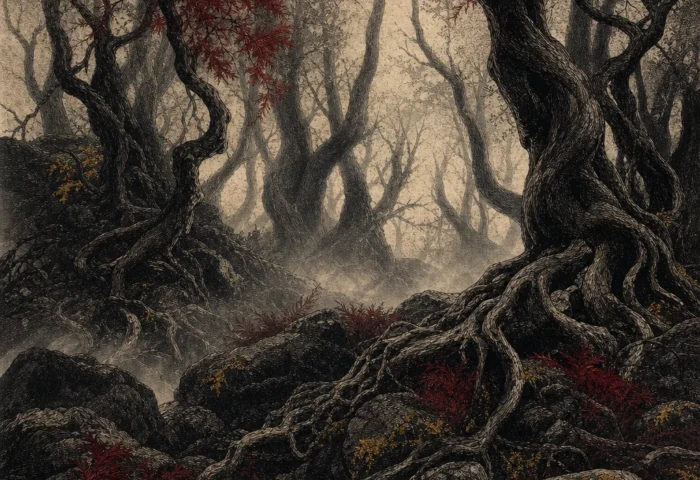
Some sites are compelling precisely because their reputation rests on a documented human story rather than any proven phenomenon. The forest of Aokigahara at the foot of Mount Fuji, for example, is wrapped in centuries of Japanese folklore about restless spirits, and it carries a real and sombre modern history as well; the folklore and the record there deserve to be treated with equal seriousness and equal respect. Elsewhere, an object or a building becomes famous less for what can be measured than for the sheer persistence and detail of the stories attached to it.
The magazine’s stance is consistent throughout: a haunted place is worth visiting in the imagination for its history, its atmosphere, and the light it throws on what people fear and mourn — not because the ghost has been proven. The most honest ghost story is the one that tells you plainly where the documentation ends and the shiver begins. Readers who enjoy holding an object up to that light will find plenty to linger over in the Cabinet of Curiosities.
What connects all of this — the fire festival and the candy aisle, the turnip lantern and the pumpkin, the Gothic castle and the multiplex, the exhumed “vampire” and the rollercoaster scream — is a single human refusal to look away from the dark. Halloween survives because it gives that refusal one licensed night a year: a night to invite death to the door, hand it a sweet, and laugh. The costumes change and the industry grows, but the impulse beneath is very old and, in its strange way, deeply reassuring. To play with fear is to admit it exists and, for a few hours, to master it. That is a trick worth keeping, and the treat is that we get to do it every year.
It is genuinely both, braided together over centuries. The season and much of its atmosphere descend from the Gaelic festival of Samhain, marking the end of harvest and the onset of winter’s dark half. The name and calendar placement, however, come from the Christian observances of All Hallows’ Eve, All Saints’ Day, and All Souls’ Day. Whether the Church deliberately overlaid an existing pagan season is debated by historians, but both threads clearly contributed to the holiday we know.
Yes. In Ireland and Scotland, lanterns were traditionally carved from turnips, and sometimes beets or large potatoes, and lit to ward off wandering spirits — chief among them Stingy Jack of the folktale. The pumpkin is an American substitution, adopted after the tradition crossed the Atlantic because pumpkins were plentiful, large, and much easier to carve than a stubborn turnip.
Vampire beliefs were widespread in Eastern Europe long before Bram Stoker’s Dracula, and they were rooted in a misunderstanding of how bodies decompose. Exhumed corpses that appeared bloated or preserved were read as undead. Scholars widely connect vampire panics to epidemic disease, since a contagion spreading through a family after a death could be blamed on the first to die. The folklore was, in effect, a pre-scientific attempt to explain contagion.
The leading explanation is the “safe scare”: horror triggers a real physical fear response while the rational mind knows there is no real danger, and that gap produces pleasure. Psychologists also point to “benign masochism,” the enjoyment of sensations the body first reads as threatening once we learn they are harmless, plus the euphoric relief when tension finally breaks. Some researchers add that scary stories offer low-stakes rehearsal for confronting danger and mortality.
There is no scientifically established evidence that any location is haunted in the supernatural sense. Most famous hauntings combine a real tragedy at their core with decades of embellishment, and investigators find that reported “evidence” typically dissolves into ordinary causes such as drafts, settling buildings, infrasound, and the powerful effect of expectation. The places remain worth exploring for their history and atmosphere, but the honest storyteller marks clearly where the documentation ends and the legend begins.
2026/06/30
A doll in a Hokkaido temple whose hair, keepers say, does not stop growing.
 2026/06/29
The dense forest at the foot of Mount Fuji has gathered centuries of ghost stories, from yūrei spirits to compasses that supposedly…