Aokigahara: The Folklore of Japan’s Sea of Trees
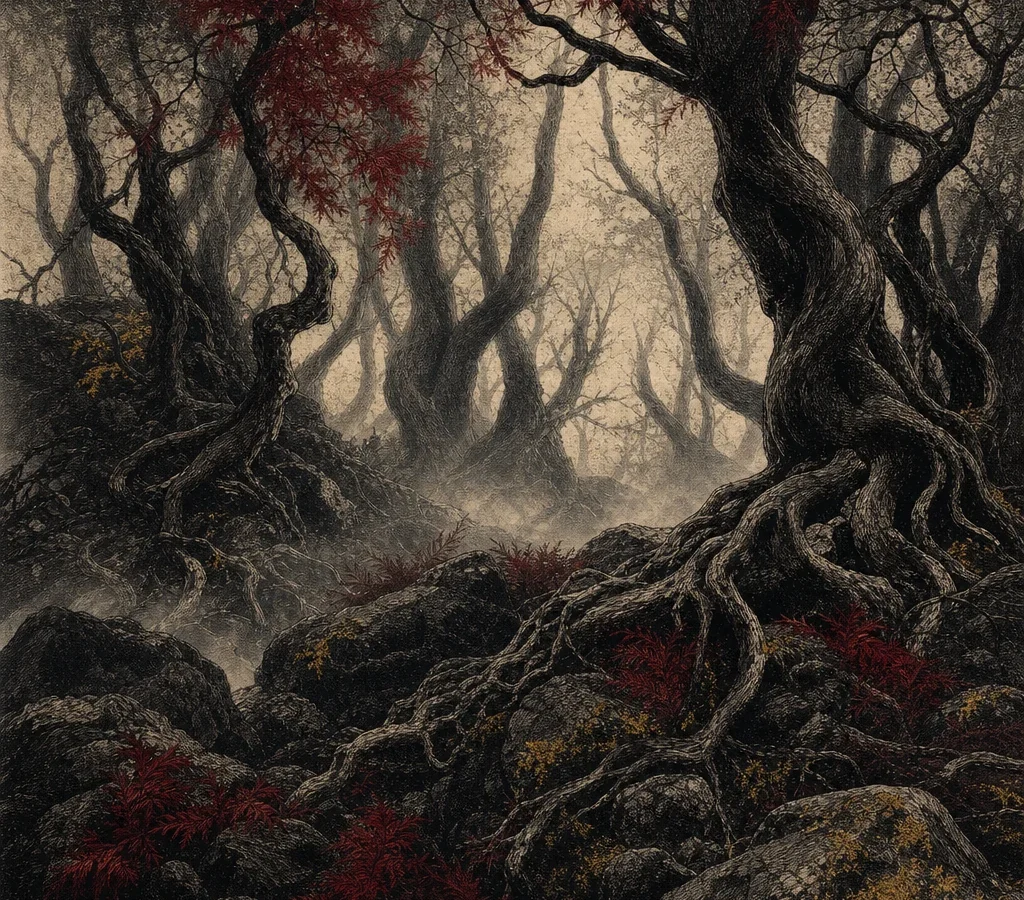
At the northwestern foot of Mount Fuji, spread across the hardened remains of an ancient lava flow, lies a forest that the Japanese call Aokigahara — the “Sea of Trees.” From an elevated vantage the name explains itself: the canopy rolls unbroken to the horizon like a green ocean, dense and level and strangely uniform. It is a place of considerable natural beauty and deep cultural resonance, home to lava caves, rare mosses, and a silence that visitors describe as almost physical. It is also a place that has, in recent decades, been badly distorted by sensational coverage abroad — reduced in the popular imagination to a single grim reputation that flattens everything else the forest is.
To meet Aokigahara honestly is to set that flattening aside and look at what is actually there: a young volcanic landscape, a body of folklore centuries old, and a living site of Japanese cultural and ecological significance.
A Forest Grown on Fire
Aokigahara is geologically young. It sits atop a vast lava field laid down by a major eruption of Mount Fuji, conventionally dated to the year 864, during the Heian period. The eruption sent molten rock spilling across the northwestern flank of the mountain, and the forest we see today grew up over the centuries on the cooled and weathered basalt. That volcanic foundation shapes everything about the place.
The ground is not ordinary soil but a rugged, uneven crust of hardened lava, riddled with hollows and fissures. Trees anchor their roots into cracks in the rock rather than sinking them deep, producing the gnarled, sprawling root systems that snake across the forest floor and give the interior its otherworldly character. Beneath the surface the lava flow is honeycombed with caves and tubes, some of which hold ice year-round; the Narusawa Ice Cave and the Fugaku Wind Cave are well-known examples that draw visitors for their natural formations.
The Quiet and the Density
Much of Aokigahara’s atmosphere comes from a combination of density and sound. The trees grow closely and the terrain blocks wind at ground level, so the forest is notably still; the porous lava and thick vegetation absorb sound, deadening the ordinary noises one expects outdoors. Wildlife is present but not abundant in the deep interior, and the effect of all this is a hush that many visitors find beautiful and a few find unnerving. The uniformity of the canopy and the sameness of the terrain can also make navigation genuinely difficult away from the marked trails — a practical hazard that has, over time, become entangled with the forest’s more supernatural reputation.
Yūrei and the Older Folklore
Long before any modern reputation attached itself to Aokigahara, the forest occupied a place in Japanese folklore. Japanese tradition is rich with belief in yūrei — the spirits of the dead who, for various reasons, have not passed peacefully on and are said to linger in the world of the living. Such spirits appear throughout Japanese ghost stories, kabuki drama, and woodblock prints, typically depicted as pale figures in white burial garments, with long dark hair and hands hanging limply before them.
Aokigahara’s stillness, its dense concealment, and its association with the great sacred mountain above it made it a natural setting for such beliefs to gather. Some folklore also connects the forest to the harsh practice of ubasute, a legendary custom said to involve abandoning the elderly in remote places in times of famine — though historians regard ubasute largely as legend and moral tale rather than documented widespread practice. Whatever its factual basis, the association lent the forest an aura of sorrow and haunting that predates the modern era by a great margin. In this respect Aokigahara belongs to a global tradition of landscapes charged with the presence of the dead, a subject explored across our writing on the paranormal and anomalous.
The Distortion of a Place
In recent decades, and especially through foreign media, Aokigahara has been reframed almost entirely around its darker associations. International documentaries, films, and viral online content seized on the forest’s most tragic reputation and made it the whole story, often in ways that Japanese commentators and local authorities have criticised as exploitative and disrespectful. The most notorious of these episodes drew widespread condemnation for treating a site of real grief as spectacle.
This coverage has done a disservice both to the forest and to the seriousness of the human suffering it invokes. It has crowded out the geology, the folklore, the ecology, and the ordinary experience of the great many people who visit Aokigahara simply to walk its trails, tour its ice caves, and see Mount Fuji from one of its most storied approaches. Out of respect for that seriousness, this account deliberately does not dwell on methods or specifics; those details add nothing to an understanding of the place and much to its exploitation. Local and national organisations in Japan maintain support resources and signage encouraging anyone in distress to seek help, and the appropriate response to the forest’s sorrowful reputation is care and discretion, not fascination.
What remains, when the sensationalism is set aside, is a landscape worth knowing on its own terms: a forest grown over a river of ancient fire, rooted in cracked black stone, wrapped in a silence that Japanese tradition has long peopled with spirits. Aokigahara is not a horror set. It is a real and significant place — geologically remarkable, culturally deep, and deserving of the same respect one would extend to any ground that human beings have long regarded as sacred and strange.