The Iron Maiden That Never Was: Anatomy of a Torture Myth
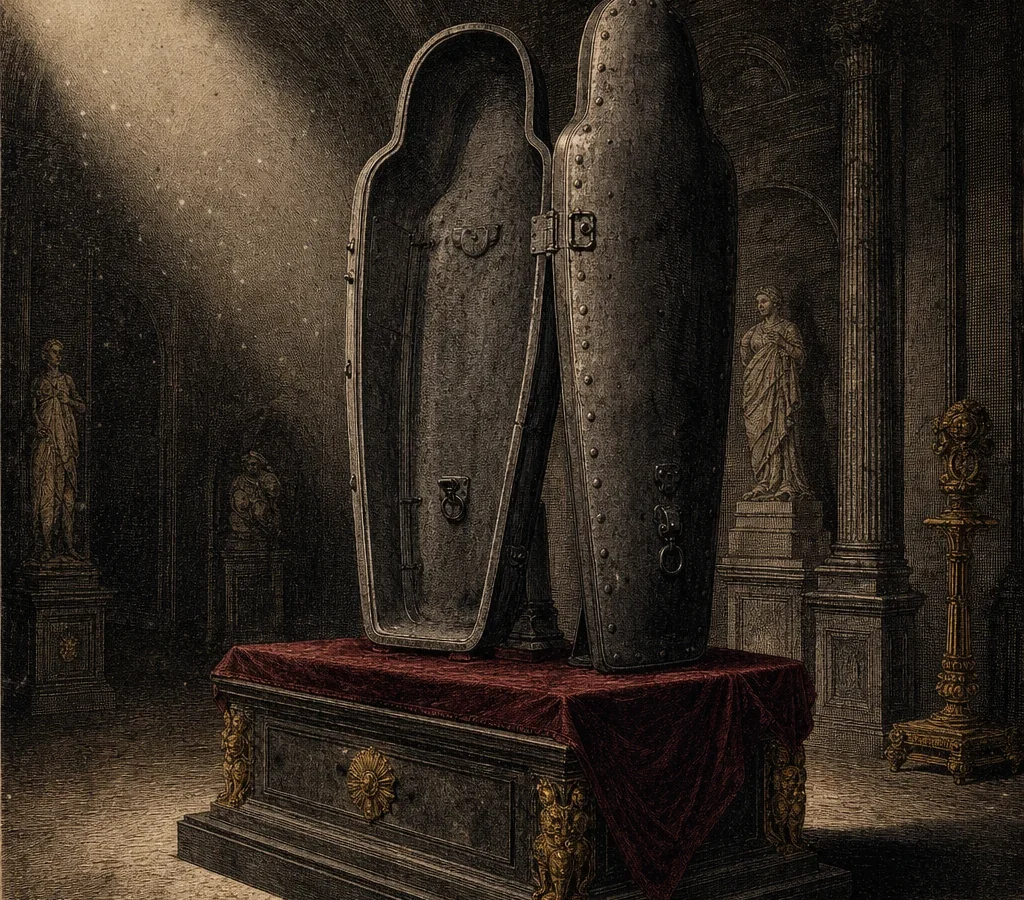
Few objects sum up the popular image of the “dark ages” so neatly as the iron maiden: a hinged, coffin-shaped cabinet, moulded on its front into the likeness of a woman, its interior studded with iron spikes positioned to pierce the enclosed victim as the doors were slowly closed. It appears in museums, in horror films, in the pages of countless books on medieval cruelty. It has a name that is almost too perfect. And it is, by the weight of the evidence, a fabrication — a device that no medieval court is known to have used, assembled and marketed centuries after the period it supposedly represents.
The story of the iron maiden is not really a story about torture. It is a story about how history gets manufactured, how a good tale outruns the facts, and how a nineteenth-century public hungry for gothic horror was happy to buy what it was sold.
The Absence at the Centre
The first and most damning problem with the iron maiden is the silence of the medieval record. Torture was, regrettably, a real and documented feature of many pre-modern legal systems, and the instruments used — the rack, the strappado, thumbscrews, the wheel — appear in court records, legal treatises, executioners’ accounts, and contemporary illustrations. These devices left paper trails because they were part of formal judicial procedure.
The iron maiden leaves no such trail. There is no reliable medieval description of a spiked, woman-shaped enclosure used to execute or torture prisoners. It does not appear in the legal literature of the period, in the manuals of the courts, or in the writings of those who witnessed and recorded the grim machinery of medieval justice. For a device supposedly so dramatic, its absence from the historical record before the modern era is total — and that absence is itself the strongest evidence that it never existed as a working instrument of the courts.
Siebenkees and the Nuremberg Maiden
The trail of the myth leads to the German city of Nuremberg and to the late eighteenth century. In the 1790s a philosopher and writer named Johann Philipp Siebenkees published an account of an execution supposedly carried out in 1515, in which a coin-forger was said to have been placed inside a spiked iron maiden and killed. This is the earliest known telling of the classic iron-maiden story, and modern historians regard it as an invention — a piece of atmospheric writing presented as historical fact rather than a report grounded in any genuine record.
From this seed grew the most famous specimen of all: the “Iron Maiden of Nuremberg.” This was a large, elaborate device that became a celebrated exhibit in the city, an apparent proof that Siebenkees’s tale was true. In reality, the object appears to have been assembled after the fact — a composite constructed from various pieces, quite possibly incorporating genuine old materials, and built to give physical form to a story that had already captured the public imagination. It was, in effect, a prop made to illustrate a legend, later mistaken for the legend’s origin.
A Perfect Product for a Gothic Age
The iron maiden emerged into a nineteenth century primed to receive it. This was the era of the Gothic novel, of a romantic fascination with a lurid, superstitious Middle Ages, and — importantly — of the travelling exhibition and the commercial museum. Purported instruments of medieval torture were exactly the sort of spectacle that drew paying crowds. Enterprising showmen assembled collections, and the iron maiden, with its lurid design and its ready-made backstory, was a centrepiece attraction.
Several elaborate iron maidens were built and displayed across Europe and later exported to collections around the world during the nineteenth century. Their craftsmanship was often genuinely impressive, which only reinforced the illusion of authenticity. To a visitor, the sheer physical presence of the thing — heavy iron, cruel spikes, that unsettling feminine face — was far more persuasive than any dry scholarly caveat. The object seemed to testify to its own history.
It is worth being precise about what is and is not disputed. The claim under scrutiny is narrow: that the iron maiden, as popularly imagined, was a real instrument of medieval judicial torture and execution. That claim collapses under examination. What is not disputed is that torture existed, that many other instruments were genuinely used, and that the surviving iron maidens are real physical objects — real objects, that is, of the modern era, built to dramatise a past that never contained them. The broader history of judicial cruelty explored across our writing on crime and punishment is grim enough without inventions; the iron maiden is notable precisely because it is the exception, the famous horror that the courts did not actually commit.
How a Hoax Becomes History
The iron maiden is a useful case study in the mechanics of false history. A single unsourced anecdote, published with the authority of a learned author, becomes a story. A physical object is later built to match the story, and the object is taken as confirmation. Popular culture amplifies the image until it is universally recognised. By the time serious scholars examine the evidence, the myth is so deeply embedded that debunking it feels almost like vandalism against a beloved piece of the past.
Modern researchers — including historians of medieval law and specialists in the history of torture such as the American scholar Wolfgang Schild and others who have surveyed these collections — have concluded that the iron maiden has no place in the genuine catalogue of medieval judicial instruments. Their work has gradually filtered into museum labels, some of which now describe these devices as later fabrications rather than authentic relics.
None of this makes the surviving iron maidens uninteresting. They remain remarkable artefacts — not of medieval cruelty, but of the modern appetite for it. They tell us less about how the people of the fifteenth century punished their criminals than about how the people of the nineteenth century imagined their ancestors, and about the enduring human willingness to believe a sufficiently frightening story. The iron maiden is a genuine historical object. It simply belongs to a different history than the one it was built to illustrate.